Code
# Import packages and working dataset
library(tidyverse)
library(haven)
library(plotly)
library(gt)

df_es <- readRDS("./data/ES2_NameSurvey_2025-09-09.RDS")# Import packages and working dataset
library(tidyverse)
library(haven)
library(plotly)
library(gt)
df_es <- readRDS("./data/ES2_NameSurvey_2025-09-09.RDS")df_es |>
mutate(
Sex_DK = if_else(as.numeric(V001a) == 4, 1, 0),
Region_DK = if_else(as.numeric(V001b) == 9, 1, 0),
Religion_DK = if_else(as.numeric(V001e) == 7, 1, 0)) |>
group_by(country_survey, id) |>
summarise(across(ends_with("DK"), mean),.groups = 'drop') |>
group_by(country_survey) |>
summarise(across(ends_with("DK"), ~sum(.x == 1)), .groups = 'drop') |>
gt() |>
cols_label_with(fn = ~str_remove(., "_DK"))| country_survey | Sex | Region | Religion |
|---|---|---|---|
| Belgium | 5 | 14 | 55 |
| Czech Republic | 0 | NA | 29 |
| Germany | 1 | 10 | 42 |
| Hungary | 0 | NA | 20 |
| Ireland | 0 | 8 | 28 |
| Spain | 0 | 0 | 0 |
| Switzerland | 1 | 28 | 103 |
| The Netherlands | 6 | 20 | 58 |
| UK | 8 | 40 | 83 |
df_es |>
  group_by(country_survey, id) |>
  summarise(across(c("V001a", "V001b", "V001e"), n_distinct),.groups = 'drop') |>
  group_by(country_survey) |>
  summarise(across(c("V001a", "V001b", "V001e"), ~sum(.x == 1)), .groups = 'drop') |>
  gt() |>
cols_label(V001a = "Sex", V001b = "Region", V001e = "Religion")| country_survey | Sex | Region | Religion |
|---|---|---|---|
| Belgium | 7 | 14 | 57 |
| Czech Republic | 1 | 640 | 89 |
| Germany | 6 | 10 | 45 |
| Hungary | 0 | 300 | 78 |
| Ireland | 9 | 9 | 32 |
| Spain | 0 | 0 | 0 |
| Switzerland | 19 | 30 | 110 |
| The Netherlands | 13 | 21 | 63 |
| UK | 18 | 42 | 87 |
Here we check the difference in response pattern based on the respondent’s demographic variables. The table below show the average region congruence rates for Nigerian names.
# Get weighted mean using the survey weight variable
get_mean <- function(var_es, wgt_es){
    weighted.mean({{var_es}}, w = {{wgt_es}}, na.rm = TRUE)
}

df_es <-
  df_es |>
  mutate(resp_sex = case_match(VS1, 1 ~ "Male", 2 ~ "Female", .default = NA),
          #resp_edu = case_match(VS3, 1 ~ "No higher", 2 ~ "Higher", .default = NA),
          resp_age = case_when(VS2 < 25 ~ "18-24", VS2 > 24 & VS2 < 46 ~ "25-45", VS2 > 45 ~ "46+"))

compare_cong <- function(country, group_comp){
  df_es |>
    filter(country_name == country) |>
    group_by(country_survey, Name, group = get(group_comp)) |>
    summarise(region = get_mean(cong_region, Weging), .groups = 'drop') |>
    filter(!is.na(group)) |>
    group_by(country_survey, group) |>
    summarise(mean = mean(region), .groups = 'drop') |>
    pivot_wider(names_from = group, values_from = mean)
}
compare_cong("Nigeria", "resp_sex") |>
  left_join(compare_cong("Nigeria", "educ_adj")) |>
  left_join(compare_cong("Nigeria", "resp_age")) |>
gt() |>
fmt_percent(decimals = 0) |>
sub_missing() |>
tab_spanner(label = "Sex", columns = c("Female", "Male")) |>
tab_spanner(label = "Education", columns = c("Lower than secondary", "Secondary +", "Other")) |>
tab_spanner(label = "Age group", columns = c("18-24", "25-45", "46+"))| country_survey |
Sex
|
Education
|
Age group
|
|||||
|---|---|---|---|---|---|---|---|---|
| Female | Male | Lower than secondary | Secondary + | Other | 18-24 | 25-45 | 46+ | |
| Belgium | 14% | 21% | 17% | 20% | 10% | 14% | 18% | 19% |
| Germany | 31% | 36% | 33% | 34% | 16% | 24% | 33% | 35% |
| Ireland | 29% | 37% | 33% | 34% | 27% | 28% | 33% | 34% |
| Spain | 7% | 17% | 13% | 11% | — | 11% | 9% | 15% |
| Switzerland | 32% | 36% | 32% | 35% | 28% | 34% | 36% | 33% |
| The Netherlands | 27% | 31% | 28% | 30% | 30% | 21% | 32% | 30% |
| UK | 34% | 39% | 34% | 39% | 34% | 22% | 35% | 40% |
The results below are based on the time spent in each session evaluating 10 names. Results refer to the second round only as the variable is not present in the first round data. The tables below also excludes sessions that took 60 minutes or more to be finalised (2.2%).
df_es |>
  filter(!is.na(Filltime_Total) & Filltime_Total < 3600) |>
  group_by(country_survey, region_es, input_1, Name) |>
  summarise(time_id = mean(Filltime_Total/60, na.rm = T), .groups = 'drop') |>
  group_by(country_survey) |>
  summarise(mean = mean(time_id), median = median(time_id),
            .groups = "drop") |>
  gt()  |>
  fmt_number(decimals = 1) |>
opt_interactive(use_filters = TRUE, use_page_size_select = TRUE)df_es |>
filter(!is.na(Filltime_Total) & Filltime_Total < 3600) |>
ggplot(aes(x = Filltime_Total/60)) +
geom_histogram(bins = 100) +
facet_wrap(~country_survey) +
theme_classic()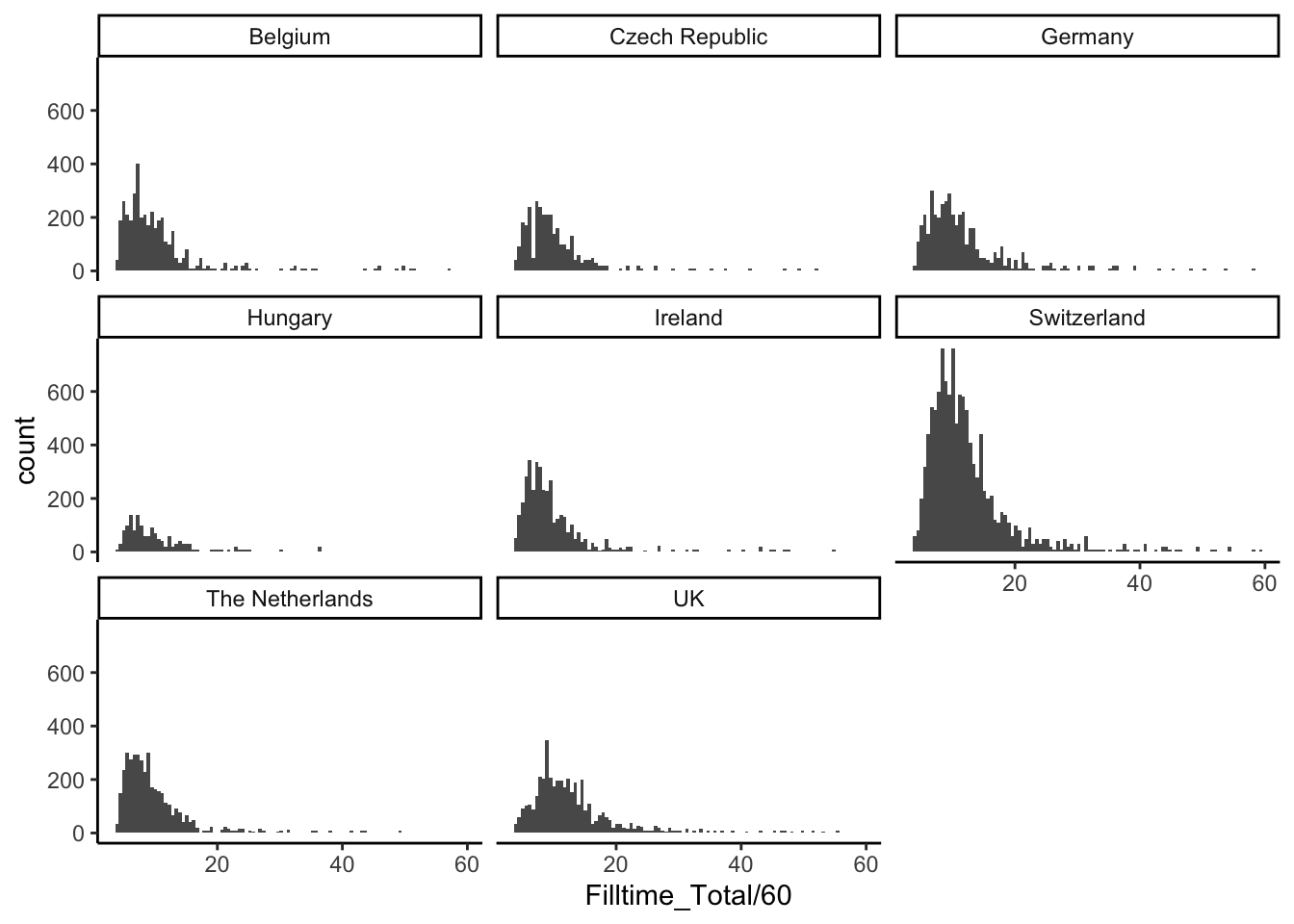
df_es |>
  filter(!is.na(Filltime_Total)) |>
  group_by(country_survey, id) |>
  summarise(time_id = mean(Filltime_Total/60), .groups = 'drop') |>
  group_by(country_survey) |>
  summarise(less_1min = sum(if_else(time_id < 1, 1, 0)),
            less_5min = sum(if_else(time_id < 5, 1, 0))) |>
gt()| country_survey | less_1min | less_5min |
|---|---|---|
| Belgium | 0 | 30 |
| Czech Republic | 0 | 21 |
| Germany | 0 | 20 |
| Hungary | 0 | 10 |
| Ireland | 0 | 25 |
| Switzerland | 0 | 25 |
| The Netherlands | 0 | 32 |
| UK | 0 | 19 |